Industrial Utility Efficiency

Industries

Adiabatic coolers are rapidly gaining ground in plastics processing as manufacturers seek sustainable, energy-efficient alternatives to traditional cooling towers. By operating in dry, adiabatic and free-cooling modes, modern systems engineered by Frigel North America deliver up to 90% water savings, lower energy consumption and improved temperature stability for injection molding, PET, extrusion and thermoforming applications. With reduced maintenance, closed-loop protection and long-term ROI advantages, adiabatic cooling is emerging as the new benchmark for high-performance industrial process cooling.

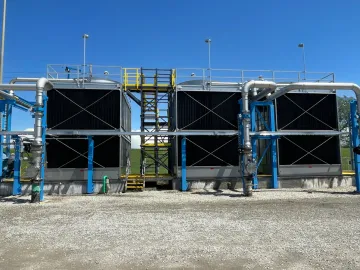
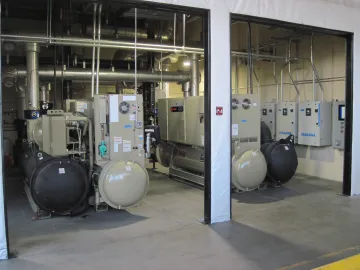
“Evaporative cooling capacity for the district system is provided by a six-cell, open-loop cooling tower capable of 6,000 tons,” said Reid Olsen, USU Central Energy Plant Manager, who has been at the university for 26 years. “This tower serves the condensers of the water-cooled chillers at the heart of the district cooling system. There are four chillers in all, two of which are rated for 1,800 tons each, and the other two are 900 tons apiece. The cooling towers reject heat from the condenser water loop via evaporative cooling, allowing the chillers to supply chilled water to the campus cooling loop.”
At the company’s production plant employees manufacture a complete range of engineered, high-performance polymers. At the heart of the operation are numerous extrusion lines and related equipment that operate 24 hours a day, five days per week to produce and ship as much as five million pounds of high-performance polymer pellets each month. The process of producing pellets begins when the rotating screw on each extruder accepts a carefully calibrated mix of thermoplastic materials, as well as additives, from a hopper and pushes the mixture into the extruder’s barrel.
In recent years, the HVAC industry has enlarged its vision from focusing on equipment efficiency measured in terms of ratings points at specific conditions to include a whole building perspective that uses models of year-long, real-world conditions. Accordingly, energy standards have adopted new rating methods to evaluate equipment efficiency during part-load operation. In Part 1 of this two-part article series we examined how these standards are evolving.
Among key initiatives at DENSO’s Maryville, Tennessee, facility is the use of an innovative ice-storage system engineered to provide environmentally friendly comfort cooling to employees at the company’s main production facility. The system also allows Plant 101 to reduce cooling costs per ton by 44%, while providing a payback of less than four years. It also resulted in an annual carbon dioxide (CO2) reduction of 18,000 tons.
When a cooling tower supporting the HVAC system at NYC Health + Hospitals/Lincoln was nearing its expected end of life, the management of the 362-bed hospital in the South Bronx saw an opportunity. The year before, the neighboring community had experienced outbreaks of Legionnaires’ disease, and even though the hospital’s cooling towers played no role in those outbreaks, the chance to increase protections against possible future exposures of the bacteria that cause the disease was an important consideration.
Snail mail. Rolodexes. Boomboxes. We’ve given up the familiarity of the past for the promise of the future. But is the same happening in the chiller industry? Is the push for lower global warming potential (GWP) refrigerants changing the industry as we know it? In some ways, yes. But, in the United States in particular, the change may be more gradual than it appears at first glance.
One of the biggest challenges brewers such as Coppertail face is maintaining the dedication to their brand’s mission and their loyal following, while expanding their reach and growing market share. That challenge means not compromising on ingredients and utilizing the best equipment available for the fermenting, brightening and packaging of their product. But, for any growing business, reliability, uptime and power costs must be quantified in order to maximize margins to make the business viable.
The craft brewing industry has exploded over the past several years. According to the Brewers Association, in 2012 there were 2,420 regional craft breweries, microbreweries and brewpubs in the U.S. By 2017 that number had nearly tripled to 6,266. The abundance of craft brewers has led to increased competition for market share among consumers, distributors and bars – leaving little to no room for error in the brewing process.
Understanding and emulating how an existing business achieved success is often one of the biggest advantages to new business start-ups. Dogfish Head Craft Brewery, one of the first large craft breweries in the United States, has become recognized as a leader in this burgeoning industry. New breweries look to Dogfish Head’s model for implementing ideas that work without experiencing the irksome (and often expensive) trial and error growing pains. 

Food

Bayer Crop Science runs a 240-acre fertilizer production facility with areas for active ingredient

Beverage

Faced with the requirement for improved cooling, a blow molding plant chose to invest in a

HVAC

Current ventilation guidelines recommend maintaining ventilation with 100% outdoor air 24/7, or as

Metalworking

In this article:Cooling for High-Speed Injection Plastic MoldingFree Cooling Results in Massive

Medical

Like many universities across America, The University of Cincinnati had a major challenge having to

Manufacturing

This article details how Schneider Electric transformed waste heat into a reliable energy source at

Plastics and Rubber

An automotive fabric products manufacturer, reduced natural gas consumption and carbon emissions by