Industrial Utility Efficiency

Cooling Towers

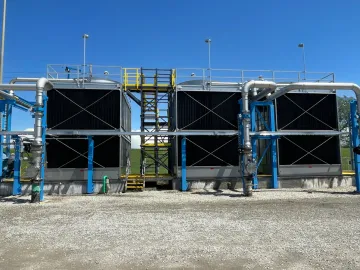
Bayer Crop Science runs a 240-acre fertilizer production facility with areas for active ingredient and chemical intermediate production, as well as a high-active herbicide production unit. Among the multiple cooling towers at the facility was a 40-year-old field-erected, three-cell, wooden, crossflow Marley cooling tower used for rejecting heat and providing cooling for multiple processes. 

How do you replace aging cooling towers without risking disruption to a plant's continuous high-volume operation? That was the challenge at a major Midwest automotive manufacturing facility. In 1998, SUVs and minivans began rolling off the production line at the 4.5 million-square-foot facility (roughly 80 football fields under one roof), and the existing cooling towers were due to be replaced. 
In October of 2023, eight hundred sales professionals from forty-one countries attended the EVAPCO Global Sales Conference in Baltimore, MD. Under the theme “Full Spectrum Evolution,” EVAPCO celebrated the talent of its global sales network, and the evolution of its full spectrum of heat transfer solutions. This article will recount the event functions and share new developments unveiled at the EVAPCO Global Sales Conference, the first since 2017. 
Evaporative condensers are an efficient and cost-effective heat rejection solution for various applications—food and beverage refrigeration, industrial machinery cooling, and HVAC. The units work by condensing superheated refrigerant vapor inside a coil that is continually sprayed with water.  As the water evaporates, fans reject the heated water vapor to the atmosphere.  By lowering system condensing temperatures, evaporative condensers reduce compressor horsepower requirements, resulting in energy savings of up to 15% when compared to air-cooled systems.
Water conservation is a high priority in designing and operating water-cooled equipment and plays an important role in USGBC’s Leadership in Energy and Environmental Design (LEED) certification and other sustainability programs. LEED assigns credit points to reduce water usage. 
The need for cooling capacity is increasing globally. An expanding population and an ever-growing dependence on data increases the need for process cooling, centralized space cooling, and data center cooling. Meanwhile, in many places, water scarcity is a massive issue. In conventional, industrial cooling applications, the use of water for heat rejection is critical. Cooling towers and most evaporative fluid coolers depend heavily on water to reject waste heat to the atmosphere.
The mission of CTI is to advocate and promote the use of all environmentally responsible commercial cooling technologies. Three committees make up CTI’s primary working groups - Engineering, Standards & Maintenance (ESM); Performance & Technology (P&T); and Water Treatment (WT). The conference featured over 35 presentations by recently published technical paper authors from the industry. 
The 2023 AHR Expo co-sponsored by ASHRAE and AHRI was held Feb. 6-9 at the Georgia World Congress Center in Atlanta, GA. A total of 1,779 exhibitors (425 international) spread across 487,000 square feet, and several dozen free educational sessions drew 42,794 total attendees. HVACR equipment manufacturers and suppliers displayed their latest innovations engineered to address the megatrends in the HVACR industry and market. This report will highlight the cooling tower, chiller/heat pump and associated technology innovation centered around electrification, decarbonization and water conservation.
This article will be of particular interest to industrial system operators unfamiliar with tankless (primarily closed) systems who may be considering either installing new systems without tanks or removing existing open tanks.  The topics covered step through an understanding of tankless systems while also including tank system pointers and insights on converting systems with tanks into tankless systems. 
This article will explore the Cooling Technologies Institute (CTI) Standard 201 (STD-201) Thermal Certification This article will explore the Cooling Technology Institute (CTI) Standard 201 (STD-201) Thermal Certification Program, share perspective from leading cooling tower manufacturers, and cover other existing and evolving CTI test codes, standards and certifications. This article will also emphasize the investment and bandwidth contributed to CTI by cooling tower manufacturers for the benefit of the industry and its end users.