Industrial Utility Efficiency

Technology

Across industries, operators are adopting cooling tower direct drive (CTDD) motor technology. In particular, permanent magnet (PM) direct drive motors are delivering measurable improvements in efficiency, cleanliness and maintenance reduction. The change is more than a component swap; it represents a new approach to cooling tower design that reduces operating costs, supports environmental goals and improves reliability. 

The AIM (American Innovation and Manufacturing) Act was finalized by the US government at the end of 2021. This legislation introduced a phase-down plan for virgin HFC gases. From now through 2036, the US will reduce the production and importation of virgin HFCs by granting relevant businesses a set number of HFC allowances (or quota), which will decrease over time. 
Process cooling systems are mandatory components of the production infrastructure in many plants. System efficiency is second only to operational performance (i.e. meeting the process requirements) in the design and operation of these systems, and many companies go to great lengths to attain system efficiency.  Many times, unfortunately, the actual system performance is well below the hoped for efficiency target.
The U.S. Department of Energy (DOE) started moving down the pump efficiency path when it began regulating certain commercial and industrial pumps in 2020. This effectively removed the least-energy-efficient pumps from the market—about 25 percent of the total. It is a good start, but real change will not be achieved unless we start replacing the installed base with more efficient pumps. The state revolving fund (SRF) programs have a green set-aside of 10 percent of their funds that must be spent on carbon-reduction initiatives. Most facilities have already identified the bad actors—equipment that often breaks down or requires maintenance.
How do you replace aging cooling towers without risking disruption to a plant's continuous high-volume operation? That was the challenge at a major Midwest automotive manufacturing facility. In 1998, SUVs and minivans began rolling off the production line at the 4.5 million-square-foot facility (roughly 80 football fields under one roof), and the existing cooling towers were due to be replaced. 
In late October 2023, professionals from around the world gathered at the Best Practices 2023 EXPO & Conference at McCormick Place in Chicago, Illinois to source and learn about Sustainble, Safe and Reliable On-Site Utilities Powering Automation including chillers, cooling towers, motors, compressed air, blowers, vacuum, pneumatics and more.
In October of 2023, eight hundred sales professionals from forty-one countries attended the EVAPCO Global Sales Conference in Baltimore, MD. Under the theme “Full Spectrum Evolution,” EVAPCO celebrated the talent of its global sales network, and the evolution of its full spectrum of heat transfer solutions. This article will recount the event functions and share new developments unveiled at the EVAPCO Global Sales Conference, the first since 2017. 
This article will discuss the instrumentation typically found in cooling systems and other plant utility systems, what other instruments and gauges should be used, how the instrumentation should be used, and good maintenance practices for instrumentation.
Evaporative condensers are an efficient and cost-effective heat rejection solution for various applications—food and beverage refrigeration, industrial machinery cooling, and HVAC. The units work by condensing superheated refrigerant vapor inside a coil that is continually sprayed with water.  As the water evaporates, fans reject the heated water vapor to the atmosphere.  By lowering system condensing temperatures, evaporative condensers reduce compressor horsepower requirements, resulting in energy savings of up to 15% when compared to air-cooled systems.

Chillers

This article will make plants aware of the energy and water use differential between CHW systems

Cooling Towers

Bayer Crop Science runs a 240-acre fertilizer production facility with areas for active ingredient

Fluid Coolers

This article explores how air-cooled heat rejection systems are reshaping industrial cooling

Dry Coolers

Adiabatic coolers are rapidly gaining ground in plastics processing as manufacturers seek

Water Filtration

Field-erected evaporative “wet” cooling towers, combined with heat exchangers, are an economical and

Heat Exchangers

Free cooling offers a highly efficient alternative to chiller-based cooling, but its success depends

Cooling Controls

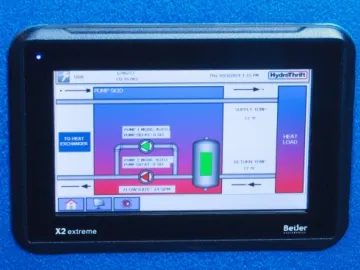
The customers wanted to be able to monitor their system from a control room. They wanted to be able